This is the news page for all IWW Departments and Unions. This page displays *all* news items from every Department and Union. To see news only from a particular Department, click on the Department title below.
For an overview of the IWW's Union structure, please visit the Unions homepage.
For branch, campaign, or general labor news, click on the appropriate sub-menu bars at the left under
the main "news" bar.
Submitted on Sun, 07/31/2005 - 1:18am
Urgent Action Needed!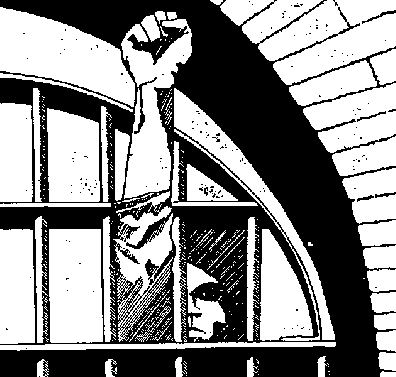
(Again, for folks in and around Kansas, KMA is again raising money to aid with these comrades!)
New Jersey Animal Rights Activists Rearrested
Following Anti-Terrorist Task Force raid and arrests last weekend, New Jersey activists have been rearrested today [7/29/2005]. They need your support now!
Nicholas Cooney has been arrested once again. He was involved in a legal protest outside Glaxo Smith Kline's King of Prussia, PA facility and taken in for an outstanding warrant in Ocean County, NJ. During the last contact with Nicholas, it was reported that he was being held in the Upper Merrion, PA jail, but will be extradited to NJ at an undetermined time. Supporters do not currently know where Nick is being held.
Please make some polite but firm phone calls to the jail to request vegan food for Nick and to inquire about his well-being. The phone number at the jail he was last known to be at is 610 265-3232.
If and when Nick is extradited (an email will go out under separate cover), he will be transferred to the Ocean County Correctional Facility in Tom's River, NJ. After he has been transferred, the phone number for jail support calls will be 732 929-2043.
Submitted on Wed, 07/27/2005 - 12:06am
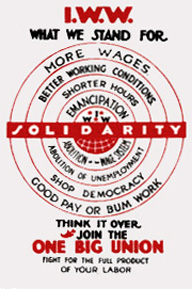 We can all agree that the AFL-CIO, and business unionism in general, is a dead-end for the working class in North America. We need a new international labor movement; one that is based on workers’ self-organization and on the recognition of the inevitable conflict between labor and capital.
We of the Industrial Workers of the World (IWW) have stayed close to our roots and feel that we have some ideas and lessons, learned from bitter experience, for such a new labor movement. We feel that a new labor movement will have to return to the strategies and tactics of the workers’ movement before it’s decent into the bureaucratic quagmire of business unionism if it is to go forward.
We have a few suggestions on how to proceed:
- Organize the unorganized into self-managed industrial unions. Unions built from the grass-roots by worker organizers. Unions run by the membership to address their own needs and aspirations on the job. Unions that are independent of government and political parties. Unions that welcome all wage workers and unemployed, regardless of nationality, race, gender, political or religious creed, sexual orientation, etc, on the basis of strict equality. Unions in which all officers are directly elected by those they serve and are immediately recallable by the membership. Unions in which remuneration for officers is tied to the average wage of the workers involved; where term limits for officers are strictly observed; and, where the officer returns to the job when their term in office is over. We call this Solidarity Unionism.
- Re-organize the miss-organized of the business unions via establishment of shop-committees that can take direct action on the job in pursuit of workers’ needs outside of the restrictions of legal collective bargaining agreements. We reject dues check-off because joining a union should be a conscious commitment to solidarity not a “condition of employment”. We reject no-strike deals because we need to be able to act to defend and extend our rights at every opportunity. We reject “management’s rights” because they are inimical to our own.
- Establish horizontal links between and among unions and shop committees to foster solidarity on a local, regional, national and international level. Build workers’ centers in every community to reach out to all sectors of the working class and unemployed, including their kids.
- Solidarity Unionism recognizes no restriction on what we should strive for. Health and safety at work, the environmental and social impact of what we produce, shorter and flexible hours of labor, universal health care - everything is fair game! Ultimately, we reject the employing class’s so-called ‘proprietary rights’. We want to gain control of the means of life!
We offer these ideas in the hope that the new labor movement that will necessarily emerge from the shipwreck known as business unionism can avoid the same mistakes of the past that have led us to the present impasse.
Submitted on Thu, 06/30/2005 - 1:49am
Visit this site, and scroll down and click on the "Wobblies" link.
Submitted on Wed, 06/29/2005 - 1:04am
Staughton Lynd’s remarks on Solidarity Unionism
To Begin With
The greatest honor I have ever received is to be asked to speak to you on the occasion of the IWW's 100th birthday.
But I am not standing here alone. Beside me are departed friends. John Sargent was the first president of Local 1010, United Steelworkers of America, the 18,000-member local union at Inland Steel just east of Chicago. John said that he and his fellow workers achieved far more through direct action before they had a collective bargaining agreement than they did after they had a contract. You can read his words in the book Rank and File. Ed Mann and John Barbero, after years as rank and filers, became president and vice president of Local 1462, United Steelworkers of America, at Youngstown Sheet & Tube in Youngstown, and toward the end of his life Ed joined the IWW. Ed and John were ex-Marines who opposed both the Korean and Vietnam wars; they fought racism both in the mill and in the city of Youngstown, where in the 1950s swimming pools were still segregated; they believed, as do I, that there will be no answer to the problem of plant shutdowns until working people take the means of production into their own hands; and in January 1980, in response to U.S. Steel's decision to close all its Youngstown facilities, Ed led us down the hill from the local union hall to the U.S. Steel administration building, where the forces of good broke down the door and for one glorious afternoon occupied the company headquarters. Ed's daughter changed her baby's diapers on the pool table in the executive game room. Stan Weir and Marty Glaberman, very much alone, moved our thinking forward about informal work groups as the heart of working-class self-organization, about unions with leaders who stay on the shop floor, about alternatives to the hierarchical vanguard party, about overcoming racism and about international solidarity.
Submitted on Sat, 06/25/2005 - 9:19pm
By CIMC - DR
 On June 27, 1905, 186 labor visionaries, including Lucy Parsons, Eugene V. Debs, Mary "Mother" Jones, William Trautmann, Vincent Saint John, and Ralph Chaplin gathered at Brand's Hall in Chicago to hear Western Federation of Miners organizer William D. "Big Bill" Haywood open the founding convention of the Industrial Workers of the World with the following words: "Fellow workers...this is the Continental Congress of the working class. We are here to confederate the workers of this country into a working class movement that shall have for its purpose the emancipation of the working class from the slave bondage of capitalism". Some speech. Some union. The American labor movement would never be the same.
Nicknamed the Wobblies, the IWW sought to recruit unskilled and exploited immigrants, people of color, women and migrant farm workers who were excluded from craft unions of skilled workers organized by the AFL. Seeking to build the "One Big Union" across industrial lines, the IWW enthusiastically promoted the concept of working class solidarity by adopting the motto "An injury to One is an Injury to All", and the revolutionary tactics of direct action - which included sit down strikes, chain picketing, flying pickets, car caravans, and other organizing inovations. IWW organizing stretched from coast to coast - in factories, mills, mines, logging camps, agricultural fields, and shipping docks across the continent. Confronted with brutal attacks from both employers and the State, including the the murder of Wobbly activists [ 1 | 2 | 3 ] the union led "free speech" fights to defend the right of workers everywhere to organize, speak out and dissent. The IWW's vocal opposition to WWI also led to the arrest and imprisonment of 165 IWW organizers. In the decades that followed, the Wobblies continued to organize among marginalized workers - frequently ignored by mainstream business unions - and their vision of a militant, radical and democratic labor movement continues to inspire new organizing efforts to this day. An IWW Chronology
Now, one hundred years later, the IWW is gathering once again in Chicago to celebrate a rich legacy of struggle for the rights of working people. Read More


