Submitted on Thu, 08/05/2010 - 3:23pm
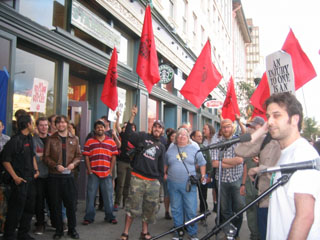 Omaha, NE- Baristas and community supporters shut down the 15th and Douglas Starbucks (SBUX) this morning demanding that management reverse all cuts to healthcare, staffing, and benefits that have been imposed during the recession. The baristas claim that executives have no justification to squeeze working families with Starbucks raking in profits of $977.2 million in the past four fiscal quarters.
"We are being squeezed, and we can't take it any more. Since the recession began, Starbucks executives have ruthlessly gutted our standard of living. They doubled the cost of our health insurance, reduced staffing levels, cut our hours, all while demanding more work from us. Starbucks is now more than profitable again. It's time for management to give back what they took from us," said Sasha McCoy, a shift supervisor at the store.
Since the onset of the recession, Starbucks imposed a series of deep cuts on its workforce. Starting in 2008 as the economic downturn began, the coffee giant shuttered over 800 stores and slashed over 18000 jobs. The remaining skeleton crew workforce was stretched out, forced to push VIA and other promotional products while keeping the stores running with insufficient staffing levels. CEO Howard Schultz then doubled the cost of the company health insurance plan in September 2009, leaving many workers unable to afford medical treatment because of sky-high
deductibles and premiums. While the cuts continue, Starbucks made a record profit of $207.9 million in the last quarter according to company figures.
The protesting baristas are members of the Starbucks Workers Union, which is an international campaign of the Industrial Workers of the World labor union. The store action makes the 15th and Douglas location the first Starbucks in Nebraska to have a public union presence. The workers decided to move to unionize after watching their standard of living be whittled away while top executives chose to reward investors with dividends.
Submitted on Thu, 08/05/2010 - 3:11pm
At Stake Are Their Jobs and $230,000 in Back Pay From Flaum Appetizing, a Kosher Food Producer in Brooklyn
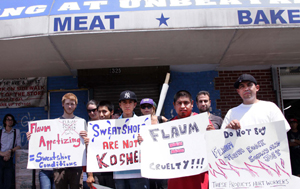 By Maia Efrem - The Jewish Daily Forward, August 4, 2010
Workers who were fired by a Brooklyn kosher food producer after demanding overtime pay have been protesting outside the owner’s house and a supermarket this summer, and preparing for a return to the National Labor Relations Board this fall.
Flaum Appetizing, Inc., a producer of kosher salads, pickles, and smoked fish, has been embroiled in the dispute since it fired17 immigrant workers in May 2008. The terminated workers had complained about working conditions and demanded to be paid overtime after working 60 to 80 hours a week. The NLRB ruled that Flaum had violated the workers’ rights, and ordered their reinstatement with back pay. Flaum has not complied, and a NLRB hearing is set for September 21.
“Our belief is that if you work, if you sweat and deliver a service, you’re entitled to have your legal rights protected, and that includes payment for your work,” said Daniel Gross, executive director of Brandworkers International, a not-for-profit organization that advocates workers’ rights and has taken up the cause along with the Industrial Workers of the World union.
“The [fired] workers are currently very active on the streets, and we seek dialogue, but we are also not afraid to fight,” Gross said.
Submitted on Tue, 08/03/2010 - 10:27am
 Headlines:
- Arizona Restaurant Workers Call For International Boycott
- Immigrant Workers Demand Justice At Kosher Food Company in New York
- A Self-Organized Restaurant In Greece
Features:
- Solidarity With The Palestinian Working Class
- Protesting the G8/G20 Summits in Ontario
- Interview: Cindy Sheehan Talks Peace & Socialism
Download a free PDF copy of this issue.
Submitted on Fri, 07/23/2010 - 7:37am
Dear brothers and sisters,
This letter is to declare the strong support of the Industrial Workers of the World (IWW) and the Pittsburgh Anti Sweatshop Community Alliance (PASCA)for the National Garment Worker Federation's (NGWF) campaign to increase the minimum wage from 1,162 Tk. to 5,000 Tk. per month. We are also declaring our support of the campaign: "No More Fires - No More Gate Lock - No More Garment Worker Deaths.”
These campaigns are sorely needed in the garment industry in Bangladesh. In February of 2010, 21 workers died as a result of fire at a garment factory in Bangladesh. Many of these deaths were a direct result of the front gates of the factory being locked, trapping workers on the premises as the fire raged. Sadly this is not an isolated incident. Since 1990 more than 400 garment workers have been killed as a result of factory fires. These deaths could have been prevented if there were adequate fire and safety measures in every garment factory. Therefore we support the NGWF campaign to bring attention to these preventable deaths. In addition to raising awareness the NGWF is also advocating that new safety laws and regulations be put in to place across the country. If laws such as these are implemented we believe many lives will be saved.
Similarly, we strongly support our brothers and sisters in the NGWF as they demand that the minimum wage be increased from 1,162 Tk. (about 24 US dollars) to 5,000 Tk. (about 71 US dollars) by 27 July 2010. The current minimum wage is grossly inadequate for any person to survive in Bangladesh, especially in and around the capital city of Dhaka. Survival on these paltry wages has been particularly difficult as the price of food and essentials has rapidly increased over the last several years. As was pointed out by Brother Amirul Hoque Amin, Bangladesh’s garment workers are the lowest paid of the major garment producing nations.
Submitted on Thu, 07/01/2010 - 8:59am
 Headlines:
- Unions Call For Blockade of Israeli Maritime Trade
- The "Deepwater Horizon" Oil Rig Disaster
- Wobblies To Sue U.S. Military For Spying And Infiltration In Olympia
Features:
- Organize For Workers' Safety
- On The Ground At The Organizing Summit In L.A.
- Fighting Notes From "Transitional" Serbia"
Download a free PDF copy of this issue.


