Submitted on Wed, 02/06/2008 - 3:11pm
Linchpin #2 (Canada)
The history of the working class is a history of remarkable innovation and constant renewal. Whenever the bosses think they have buried forever the threat of workers' revolt, workers find, time and again, the means to fight back. Today, the recent blooming of resistance among workers in the low-wage service-sector is one important sign of a renewed struggle against the bosses and their system, writes Lucian.
For decades companies in the service - sector, whether they be giants such as Wal-Mart or smaller locally-owned businesses, have been able to hyper-exploit workers imposing low-wages, irregular schedules, temporary work, unsafe working conditions, harassment and discrimination while racking in super-profits.
Submitted on Wed, 02/06/2008 - 2:51pm
link: click here.
 Building Bridges: Your Community and Labor Report
National Edition
Produced by Ken Nash and Mimi Rosenberg
28:18
Building Bridges: Your Community and Labor Report
National Edition
Produced by Ken Nash and Mimi Rosenberg
28:18
*************************
Taming Wild Edibles
with
The Industrial Workers of the World
In addition to its own seafood restaurants, Wild Edibles' ware-house provides seafood to some of New York's most famous
eateries including Tavern on the Green and La Goulue. Yet, Wild
Edibles warehouse workers are laboring under illegal and
exploitative conditions.They have filed a class action lawsuit for
unpaid overtime and have joined a labor union, the Industrial
Workers of the World. Wild Edibles has responded with illegal
retaliation including firing nine of the workers. The I.W.W.
demonstrated recently outside one of the companyâs Midtown
restaurants in their campaign for workers rights at Wild Edibles.
***************************************
Submitted on Thu, 01/31/2008 - 5:55pm
 This week will mean a return to campus for thousands of University of New Mexico students beginning their spring semester. Meanwhile, two former UNM employees will come back to UNM not to resume the jobs they loved, but to protest their recent terminations. They will gather with community allies, coworkers, and members of the IWW at the new George Pearl Hall located on the corner of Cornell and Central. There they will speak out about the lack of respect that UNM management has for university employees and what happens when workers speak up about health and safety issues.
RETIRE OR BE FIRED
Mike Swick had worked for UNM for 19 years when he was forced into early retirement. Mike is a former library facilities coordinator as well as a cofounder of the United Staff UNM union.
Submitted on Tue, 01/29/2008 - 1:35pm
 Andrew Serwer
Managing Editor
Fortune Magazine
1 Time Warner Center
New York, NY 10019
January 28, 2008
Dear Mr. Serwer,
I take serious issue with the erroneous information regarding
Starbucks in Fortune Magazine's 2008 '100 Best Companies to Work For'.
I am especially concerned about the reliability of Fortune given that
the IWW Starbucks Workers Union wrote you an open letter
before the 2007 '100 Best Companies to Work For' feature that pointed
out the very same misinformation which you proceeded to include once
again in the 2008 list.
The 2008 'Best Companies to Work For' list claims that the most
common hourly job at Starbucks is a mysterious position called
"Coordinator III" which takes in $37,390 per year. Once again, the most
common hourly job at Starbucks, by far, is a position called "Barista"
which likely takes in approximately $12,000 per year on average. The
precise average pay for baristas is not known since Starbucks refuses
to make that information public.
Submitted on Tue, 01/29/2008 - 1:25pm
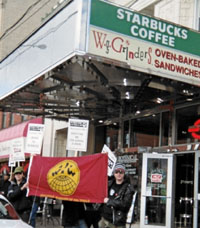
Disclaimer - The opinions of the author do not necessarily match those of the IWW. The image pictured to the right did not appear in the original article, we have added it here to provide a visual perspective. This article is reposted in accordance to Fair Use guidelines.
By Elizabeth Manapsal - Cornell Daily Sun, January 28, 2008
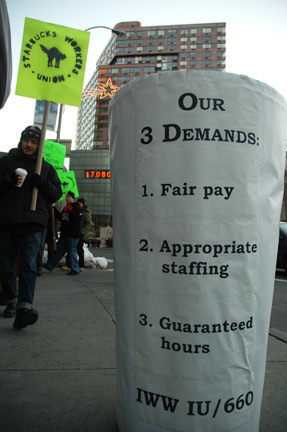 Companies are finding even more ways to screen job applicants — by
checking club discussion boards. Starbucks Corp., the nation’s leading
coffee retailer, is under scrutiny after a series of e-mails revealed
the company’s anti-union practices. The pinnacle of the events in
question came when Starbucks managers read through the discussion
boards on Cornell Organization for Labor Action’s website in order to
identify job applicants and current employees that were labor
activists.
Companies are finding even more ways to screen job applicants — by
checking club discussion boards. Starbucks Corp., the nation’s leading
coffee retailer, is under scrutiny after a series of e-mails revealed
the company’s anti-union practices. The pinnacle of the events in
question came when Starbucks managers read through the discussion
boards on Cornell Organization for Labor Action’s website in order to
identify job applicants and current employees that were labor
activists.
In a series of e-mails uncovered by The Wall Street Journal,
Starbucks managers pulled names from the discussion board and then
cross-referenced them with an employee database. They found that three
employees were members of the University’s School of Industrial and
Labor Relations and active union supporters, and asked executives if
they could inform local managers of the workers’ identities.


