Submitted on Wed, 05/09/2007 - 3:57am
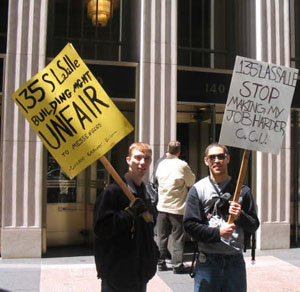 Wednesday, May 2nd, 2007 - At 11am, the Chicago Couriers Union (IWW, IU540) rolled up to 135 South LaSalle Street (between Monroe and Adams) with, signs, fliers, and union flags for a spirited 3-hour informational picket against the security policies of the building, which is managed by Jones Lang LaSalle. Last fall, union members had written letters and had over 100 bike messengers sign a petition, in hopes of having the policy changed and to have a messenger center installed, only to be given the run-around by building management.
In this and many other buildings downtown, messengers must endure humiliating and time-consuming security procedures to simply do their jobs: entering through a loading dock, leaving their bags (as if they're criminals), and waiting for a freight elevator (rather than just taking passenger elevators through the lobby), and often taking abuse from security guards. Forcing messengers into this mess can take 15-20 minutes, costs customers money, costs messengers money, results in a loss of productivity across the industry, and is just plain Not Cool with most bikers working downtown, who are paid on commission per delivery.
Two messengers held the picket for its duration, and several fellow messengers, plus a member of the local IWW General Membership Branch, spent time holding signs and handing out fliers to fellow workers, employees in the building, and other passersby. The picket covered the front and back entrances, plus both entrances of the alley leading into the loading dock. Hundreds of fliers were distributed, containing information about the grievance.
Submitted on Wed, 05/09/2007 - 3:51am
Originally posted by Sheffield Food Not Bombs to uk.indymedia.org on May 8, 2007.
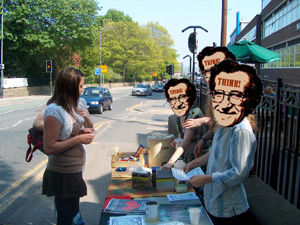 On Saturday 5th May Sheffield Food Not Bombs staged a picket outside the Broomhill branch of Starbucks in solidarity with the IWW’s “Justice from Bean to Cup” campaign:
"Justice from Bean to Cup!" - A Human Rights Campaign in Solidarity with Starbucks Baristas and Coffee Farmers
Despite its attempt to create a socially responsible image, Starbucks’ failure to meaningfully embrace Fair Trade coffee and transparent purchasing has left coffee farmers and their children teetering on the brink of starvation in the Global South.
In Starbucks cafes, baristas are paid a poverty wage and the company insures a lower percentage of employees than Wal-Mart. Starbucks baristas are organizing a union with the IWW (Industrial Workers of the World) for a better life on the job in the face of a fierce and unlawful union busting effort by the world's largest coffee chain.
The stall itself ran unexpectedly smoothly. Free coffee, tea, jaffa cakes and crisps were offered as an alternative to the overpriced drinks and food sold by Starbucks. The manager, who not surprisingly failed to appreciate the irony of Food Not Bombs using the same “aggressive marketing” strategy Starbucks uses to force other local coffee shops out of business, demanded the picket leave immediately else the police would be called. However, when the police showed it became clear that they dislike Starbucks’ attitude to employees and humanity in general as much as Food Not Bombs do, allowing the picket to continue. On the whole it was great to see so many members of the public actively interested in the disgraceful role Starbucks plays in union busting and abusing third world developers.
Submitted on Wed, 05/09/2007 - 3:29am
The author of this article is not a member of the IWW, and the do not necessarily support our organization or this campaign.
 By Ed Ericson Jr. - City Paper OnLine, May 9, 2007
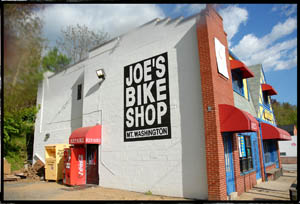
It's day three of the union at Joe's Bike Shop in Mount Washington, and owner Joe Traill steps outside to say that nothing has changed "so far."
Traill wears a worried look and chooses his words carefully so he won't sound too defensive. On May 1 he learned that all 10 of his employees had joined the Industrial Workers of the World (IWW)--the storied Wobblies.
"My guess is the significance of May Day was not lost on them," he says.
The IWW formed in 1905, and while it never numbered more than about 200,000 members, its radical influence is still felt today. Wobblies got the eight-hour day for lumberjacks, put backbone in the dockworkers unions, integrated racially and across gender lines, were imprisoned for sedition, and were lynched. Legendary leftists like Big Bill Haywood, Mother Jones, and Joe Hill were red-card-carrying Wobblies, and the men and women of the rank and file were tough, fearless class warriors fighting mine barons and government repression.
And now all that history is falling on Traill's head.
Josh Keogh, who has worked at Joe's Bike Shop for seven years and says he'd like to work there indefinitely, led the union effort. He is 23 years old and only one credit from graduating with a bachelor's degree in American studies from the University of Maryland. Unlike many students, he is not saddled with student loans in the five or six digits. "There was plenty of money in the family to put me through College Park," he says.
Keogh says he really likes his boss.
"He's really been somewhat of a mentor to me--he hired me when I was like 15 years old," Keogh says. "But this is more about what we think is fair and what we think is just and how we're going to go about getting it."
Keogh says the top wage at the shop is $32,000 a year, with no health benefits. The full-timers with health insurance get $12 an hour, he says, which is about the going rate at bike shops.
Wages aren't the issue so much as information and consistency, Keogh says. "Part of what we're looking for is more transparency in business practices. Obviously nobody here wants Joe to go out of business, [but] we don't really know what he can pay us." He says the union has asked Traill to open his business records in preparation for negotiations. Unlike other unions, the IWW doesn't go in for contracts with no-strike clauses, so the ball is in Traill's court. The business review will come "after summer--after the busy season," Keogh says.
And so things go on as they always have at Joe's, except now there's a bright class distinction between Joe and everyone else who works there. Traill, who bought the shop in 1999, says he doesn't think anyone in his family has any experience with a union--either as a member or as management. He says he "barely" graduated high school.
For now, Traill plans to "wait and see," he says. "I don't know what else to do. This is a new experience for me."
Submitted on Thu, 05/03/2007 - 2:41pm
 All of the ten employees at the Mt. Washington Bike Shop have joined the Industrial Workers of the World, one of the oldest and most storied unions in our country. The workers have taken these actions in order to secure and improve their jobs in the “best bicycle shop” in Baltimore.
The demands by the union center largely around the lack of employee policy. Before the union there was no system for scheduled raises, sick days, or vacation policy. Decisions were the sole prerogative of the boss. Now a reasonable consensus must be reached regarding these important factors of running a business.
“I feel a sense of empowerment,” says Johnny May, one of the full time employees at Joe’s Bike Shop. “ The union has given me a more active role as a more active role as a worker.”
The Mt. Washington Bike Shop workers have chosen to affiliate with the Industrial Workers of the World because they are an organization that is dedicated to shop floor democracy. “There are no professional organizers telling us what is in our best interest. Every member is an organizer, every member is a leader.” says Josh Keogh, another full time worker.
While a local small business might seem a odd place for a union, full time worker Kris Auer makes it clear that “It is not a direct attack on the owner; it is a step toward securing my future.”
Joe’s will join Red Emma’s, Baltimore’s radical bookstore and coffee shop, as the second IWW shop in baltimore. Both workplaces anticipate this federation of industrial democracies will grow and prosper in the near future.
For more information about the Mt. Washington Bike Shop Workers Union, or to schedule an interview please call Josh Keogh at 410-627-3715, or email
jskeogh (at) umd.edu
Submitted on Thu, 05/03/2007 - 3:02am
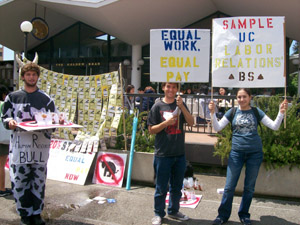 By Tristan Bunner, Bay Area IWW
(Tristan is an IWW member, a Cal student and a worker at Foothill Dining Commons. He is a founding member of Student Worker Action Group.)
At the University of California, Berkeley, student workers are fighting for equal pay. Cal students who work for the school's dining facilities, run by Cal Dining, get paid over $2/hr less than their coworkers who do the same work. The starting wage for Cal students under the classification "Student Food Service Worker" is $9.11/ hr, while the starting wage for "Food Service Workers", including high school and community college students working part time, is $11.25/hr, and another raise may be coming soon.
The difference began in August 2006, when a new union contract raised the wage of full time workers from $9.11/hr to the new rate. This raise was then applied to unrepresented part-time workers, but not to Cal students. When Cal student workers found out about the pay difference they got together and began to organize. In December 2006 they formed the Student Worker Action Group (SWAG), and began their fight for equal pay.


