This is the news page for all IWW Departments and Unions. This page displays *all* news items from every Department and Union. To see news only from a particular Department, click on the Department title below.
For an overview of the IWW's Union structure, please visit the Unions homepage.
For branch, campaign, or general labor news, click on the appropriate sub-menu bars at the left under
the main "news" bar.
Submitted on Thu, 07/13/2006 - 7:55am
American Storyteller Chris Chandler is coming back to Vancouver!
Most will know him from when he performed here with Anne Feeney, but he has a new partner now, the very talented David Roe.
They will be performing here on:
Tuesday, July 18, 2006, 9 PM
at The Foundation
Main St. & 7th Ave.
Entrance by donation $5 to $20 and
nobody turned away!
This is also the 101st anniversary party of the IWW Vancouver, with special guests The Joey Only Outlaw Band and Justicia For Migrant Workers.
The Foundation was a proud supporter of the Modern Auto Plating strikers of Steelworkers Local 2952 during their extremely long dispute nearby.
Chris and David are longtime supporters of labour and social justice
Submitted on Mon, 06/12/2006 - 3:15am
Companer@s!
Con el crecimiento desde los ultimos anos de nuestro organizacion en comunidades de trabajador@s que hablan principalmente espanol, es evidente la necesidad de propaganda como: folletos, documentos oficiales, revistas y contenido en iww.org. En conversaciones con otros miembros y simpatizantes del IWW, existe el interes en realizar y obtener los recursos para este proyecto. Un boletin del IWW en espanol es util para el trabajo de comunicacion en las comunidades donde se habla español y el IWW es activo. El grupo de trabajadores y simpatizantes del IWW en Mexico desean colaborar con articulos para el proyecto, porque seria una forma de comunicacion excelente para las organizaciones y sindicatos en America Latina y España, que el Comite de Solidaridad Internacional tiene relaciones con ellos; es un buen ejemplo de proyecto sin fronteras! Considero los siguientes conceptos basicos como una propuesta para el boletin:
Submitted on Tue, 06/06/2006 - 1:05pm
By Adam Welch - Industrial Worker, June 2006
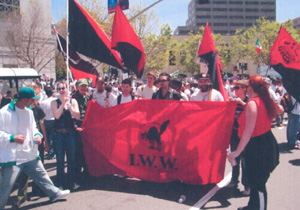 From California to the northeastern seaboard and the deep south, May 1st was marked by massive demonstrations. People poured into the streets of over 200 U.S. cities in support of immigrant workers' rights as part of the "Grand Paro Americano de 2006," or the Great American Boycott of 2006. With between two and three million participating, it was largest single day of protest ever in the United States.
But the day was far more than a movement of mass demonstrations, as nation-wide restaurants were shuttered, meat processing plants were idled, ripe fruit laid waiting to be picked and the nation's largest port stood at a near standstill. Classrooms were empty in some cities as well, as students, often joined by teachers and staff, skipped school in support. Many of those participating in the "Day Without An Immigrant," both documented and undocumented immigrants along with their supporters, heeded the call by some groups to not work, buy goods or attend school. The tactic is a traditional one called paros civicos, borrowed from social movements in Mexico.
Submitted on Tue, 06/06/2006 - 12:58pm
Staff Report - Industrial Worker, June 2006
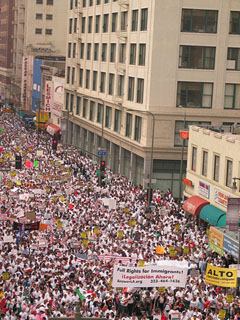 Thousands of businesses across the country closed their doors May 1st -- some because there were no workers, others because managers preferred to avoid a fight with their employees that they could only lose. Many more worked short-staffed.
In Latino barrios throughout Los Angeles, Washington, Chicago and Miami, thousands of restaurants, warehouses, newsstands, and money transfer services were closed. Many McDonald's outlets cut hours or shut down.
In Los Angeles, hundreds of sweatshop garment factories were closed. The strike paralyzed construction sites and industrial food production plants across the country.
"It was one thing to march," said Armando Navarro of the California-based National Alliance for Human Rights, referring to the earlier wave of immigrant protests. "Now we're going to hit Ôem where it hurts Ð in the pocketbooks."
Cargill, the country's second-largest beef producer, closed seven meat-processing plants employing 14,000 workers. Tyson, Perdue and other meatpackers followed suit. Tens of thousands of farm workers stayed out of the fields, and the American Nursery and Landscape Association estimated that 90 percent of the half million workers in its industry took the day off.
According to Jack Kyser, an economist with the Los Angeles Economic Development Corp., the economic impact of the strike could total $200 million just in Los Angeles County. No one has done similar calculations for the rest of the country, but the total would have to run more than a billion dollars.
While several companies threatened to fire or discipline workers who took off work for the day, and some carried out those threats, many employers' associations urged caution -- warning that such actions could lead to further actions.
"Law firms have been advising their clients that the immigrant labor boycott is protected by the National Labor Relations Act, even though it isn't specifically a union action," reported the May 2 Wall Street Journal, which had real-time coverage of the May Day actions in its online edition.
Submitted on Tue, 05/30/2006 - 1:08pm
By Harvey Goldberg - Epicenter News Service; Reposted from East Bay News Service.
Events marking May Day, International Workers Day (May 1st), hit a new high in 2006, with major events occurring on every continent and millions of workers mobilized. Workers and their representatives took the day to stand up for their rights and interests, commemorate their achievements, and to wage new struggles.
May Day events made headlines around the world, particularly in South America and, surprisingly, in the United States, where May Day was born,but had largely been forgotten.
Long gone are the Cold War days when May Day was most noted for the military displays by the Soviet Union and China, and when Communist regimes and movements seemingly held the franchise on May Day.
Contemporary May Day events are about rank and file mobilizations which revolve around key working class struggles particular to each country, though a strong sense of international solidarity also pervades them. Most are organized by labor unions, mass movements, and a variety of left-wing political parties. Communists continue to be involved, but no longer play a leading role in most countries. Only Cuba, with its prestige gained in standing up to the U.S., continues to be held in high esteem at many May Day events.


