Submitted on Wed, 02/20/2008 - 5:57pm
 FOR IMMEDIATE RELEASE
TUESDAY, FEBRUARY 19,
2008
CONTACT:
Matthew Andrews
IWW Organizer
cell:
617-633-1857
email: [email protected]
web:
www.harvestmembers..
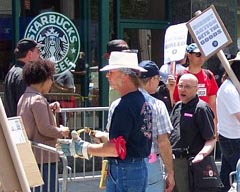
This Saturday, February 23rd, fired worker Deon
Furtick will be protesting to get his job back along with concerned Harvest
Co-op members, and supporters from the Industrial Workers of the World. The
picket will be outside a meeting of the Harvest Co-op's board of directors, at
the Paulist Center, 5 Park Street, from 8:00am to 4:00pm. Harvest board members
are having a day long "retreat" to develop "long term objectives and hopes for
the board's work and Harvest"
(http://www.harvest.coop/board/agenda01_08.pdf).
Submitted on Mon, 02/18/2008 - 10:33am
Saturday, February 16, 2008.
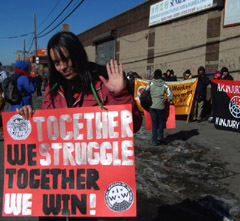
Approximately one dozen fellow workers from the Twin Cities General Membership Branch of the Industrial Workers of the World marched in support of immigrant rights and struggles in Minnesota on Saturday. The demonstration was organized by MIRAC, the Minnesota Immigrant Rights Action Coalition.

The rights of immigrant workers - both documented and undocumented - is part of a nationwide discussion during this election year, and an international discussion. The terms of the discussion are often the same in today's neoliberal environment. The reactionary right demonizes all those who are forced or choose to travel in search of security, opportunity, and a life; the reactionary left pretends that this is merely a moral issue and ignores the economics of immigration, and the 'muddled middle' hold a variety of contradictory opinions.
Submitted on Wed, 02/06/2008 - 3:56pm
By M.K. and other members of the Bay Area Utility Service Workers iu670 industrial organizing committee.
 The
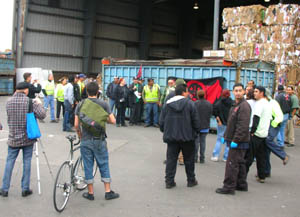
contract negotiations between the Bay Area IU 670 Recycling Workers
Union and the two Berkeley Recycling Companies has been a challenging
struggle, but workers have stepped up to fight for tremendous
improvements. The Bay Area IWW represents drivers at The Ecology
Center who do residential curbside pickup, and workers at The
Community Conversation Center yard who sort and process recycling
materials. Both workers have been waging shopfloor struggles to
resolve grievances and improve their working conditions. With both
contracts coming up for negotiations, workers stepped up the fight.
The
contract negotiations between the Bay Area IU 670 Recycling Workers
Union and the two Berkeley Recycling Companies has been a challenging
struggle, but workers have stepped up to fight for tremendous
improvements. The Bay Area IWW represents drivers at The Ecology
Center who do residential curbside pickup, and workers at The
Community Conversation Center yard who sort and process recycling
materials. Both workers have been waging shopfloor struggles to
resolve grievances and improve their working conditions. With both
contracts coming up for negotiations, workers stepped up the fight.
The
drivers met several times both at work and outside of work to draft
an ambitious list of roughly 15 demands including an across the board
wage hike, increase in pension payments by the company, and a change
to the current accident penalties. The existing agreement resulted
in termination of any driver who was involved in three accidents
incurring more than $1400 worth of damage. With the narrow winding
streets of Berkeley and the increasing costs of small accidents like
broken rear-view mirrors, we have seen several workers purposefully
dropping down to a loader after two incidents. This has resulted in
wage decreases of up to $10 per hour!
Submitted on Wed, 02/06/2008 - 3:42pm
by Diane Krauthamer - February 3, 2008
 Wouldn’t it be a real travesty to spend $50 on a wonderful
lobster dinner at New York City’s highest rated restaurant, only to
find out after your meal that the food was rotten?
Wouldn’t it be a real travesty to spend $50 on a wonderful
lobster dinner at New York City’s highest rated restaurant, only to
find out after your meal that the food was rotten?
Behind the scenes at New York City’s #1 rated restaurant
Of course, fine dining establishments must comply with health and
safety standards in their kitchens. Of course, establishments ranked as
NYC’s most popular wouldn’t dare serve rotten seafood. But there may
not be any rotten seafood at all—this is only on the surface. Something
happens well before the seafood even reaches the kitchen and it will
make you even sicker.
Submitted on Wed, 02/06/2008 - 3:27pm
Originally published at UK Indymedia
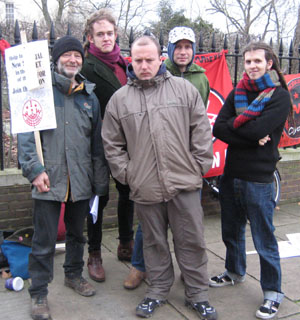 The last year saw the
IWW and their allies launch a nation-wide campaign to prevent NBS
management from enacting dangerous cuts that will only serve to ease
their own workload. IWW members in the NBS’s recognised unions (Unison
and Unite) have also been at the forefront of the campaign to push the
big unions to act against the plans, rather than seemingly roll over
and let management do whatever they want.
The last year saw the
IWW and their allies launch a nation-wide campaign to prevent NBS
management from enacting dangerous cuts that will only serve to ease
their own workload. IWW members in the NBS’s recognised unions (Unison
and Unite) have also been at the forefront of the campaign to push the
big unions to act against the plans, rather than seemingly roll over
and let management do whatever they want.
NBS
bosses plan to centralise thirteen blood processing centres into three
‘supercentres’ in Colindale, Manchester and Bristol. This means 600
jobs will be slashed and local economies and labour markets are going
to be hit hard. What’s more, the transport of blood will be even more
reliant on our already-overcrowded and polluting road system, with many
hospitals more than 100 miles from the nearest centre. Put simply,
these plans are a danger to workers, communities and patients.


