Submitted on Tue, 06/06/2006 - 1:05pm
By Adam Welch - Industrial Worker, June 2006
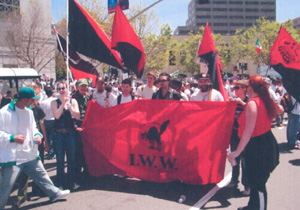 From California to the northeastern seaboard and the deep south, May 1st was marked by massive demonstrations. People poured into the streets of over 200 U.S. cities in support of immigrant workers' rights as part of the "Grand Paro Americano de 2006," or the Great American Boycott of 2006. With between two and three million participating, it was largest single day of protest ever in the United States.
But the day was far more than a movement of mass demonstrations, as nation-wide restaurants were shuttered, meat processing plants were idled, ripe fruit laid waiting to be picked and the nation's largest port stood at a near standstill. Classrooms were empty in some cities as well, as students, often joined by teachers and staff, skipped school in support. Many of those participating in the "Day Without An Immigrant," both documented and undocumented immigrants along with their supporters, heeded the call by some groups to not work, buy goods or attend school. The tactic is a traditional one called paros civicos, borrowed from social movements in Mexico.
Submitted on Tue, 06/06/2006 - 12:58pm
Staff Report - Industrial Worker, June 2006
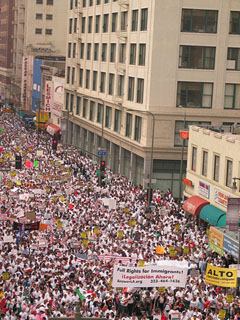 Thousands of businesses across the country closed their doors May 1st -- some because there were no workers, others because managers preferred to avoid a fight with their employees that they could only lose. Many more worked short-staffed.
In Latino barrios throughout Los Angeles, Washington, Chicago and Miami, thousands of restaurants, warehouses, newsstands, and money transfer services were closed. Many McDonald's outlets cut hours or shut down.
In Los Angeles, hundreds of sweatshop garment factories were closed. The strike paralyzed construction sites and industrial food production plants across the country.
"It was one thing to march," said Armando Navarro of the California-based National Alliance for Human Rights, referring to the earlier wave of immigrant protests. "Now we're going to hit Ôem where it hurts Ð in the pocketbooks."
Cargill, the country's second-largest beef producer, closed seven meat-processing plants employing 14,000 workers. Tyson, Perdue and other meatpackers followed suit. Tens of thousands of farm workers stayed out of the fields, and the American Nursery and Landscape Association estimated that 90 percent of the half million workers in its industry took the day off.
According to Jack Kyser, an economist with the Los Angeles Economic Development Corp., the economic impact of the strike could total $200 million just in Los Angeles County. No one has done similar calculations for the rest of the country, but the total would have to run more than a billion dollars.
While several companies threatened to fire or discipline workers who took off work for the day, and some carried out those threats, many employers' associations urged caution -- warning that such actions could lead to further actions.
"Law firms have been advising their clients that the immigrant labor boycott is protected by the National Labor Relations Act, even though it isn't specifically a union action," reported the May 2 Wall Street Journal, which had real-time coverage of the May Day actions in its online edition.
Submitted on Tue, 06/06/2006 - 12:49pm
By x345292 - Industrial Worker, June 2006
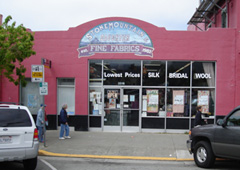 After six months of preparation and negotiation eighteen workers at Stonemountain and Daughter Fabrics in Berkeley, California, ratified a renegotiated agreement with store owners Suzan and Bob Steinberg.
The road to the final agreement was bumpy, twisting and fraught with peril. For example, a small group of workers tried to decertify the union. They worked steadily to build support among their coworkers. When they missed a legal window of opportunity (between 90 and 60 days prior to the expiration date of the contract) they red-baited and attempted other smear tactics.
As with most retail business, Stonemountain hires mostly part time workers, pays low wages with no benefits and turn-over is high. The union has changed these conditions somewhat. Still, most of the workers who voted for the union in 2003 have left or were fired. By the time meetings began to discuss proposals for a new contract the shop was in disarray. One of the new workers, Holly, agreed to be shop delegate replacing Wayne, who was one of the original core of union organizers but needed a break. In the meantime several of the new hires had not been signed up. As time went on they formed the core of the anti-union workers. Included among them was a long-time employee who likes to play boss. In the middle were several workers who repeatedly shifted sides.
Submitted on Sun, 06/04/2006 - 3:35pm
Disclaimer - The following article is reposted here because it is an issue with some relevance to the IWW. The views of the author do not necessarily agree with those of the IWW and vice versa.
 By Chris Kutalik - June 2006
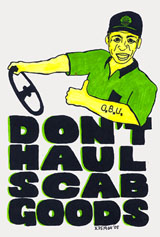
During the countdown to Los Angeles truckers struck in solidarity with immigrants and over their own working conditions. Photo: Axel Koester the May Day immigrant walkouts, transportation industry commentators worried about the impact that immigrant strikes would have on the nation?s ports. Many feared repeats of the 2004 and 2005 strikes by mostly immigrant Latino port truckers (or troqueros), which crippled freight traffic up and down the West Coast.
Submitted on Wed, 05/31/2006 - 1:59am
'Rogue Corporation' is Flouting the Law with Impunity
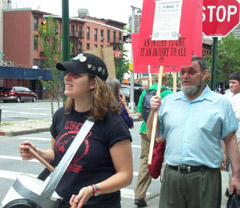 New York, NY- Still reeling from a defeat at the National Labor Relations Board in March, Starbucks was hit with a fresh legal charge from the IWW Starbucks Workers Union today. The Labor Board charge outlines continuing discrimination and retaliation against union baristas by the world's largest
coffee chain. The legal filing and supporting evidence establish that Starbucks has breached the settlement agreement reached with the government less than three months ago.
“If there was any doubt in the past, Starbucks now has made clear its anti-worker intentions,” said the union's General Counsel, Stuart Lichten, of Schwartz, Lichten, and Bright. “The company is violating one bedrock labor rights principle after another.”


