This is a report written by two IWW organizers from out of state on the activities of the union during the height of the protests in Madison and Wisconsin. The version is slightly modified from a text sent to the 2011 Delegate Convention and reflects the opinion of the authors.
By Juan Conatz and Brendan Sawyers
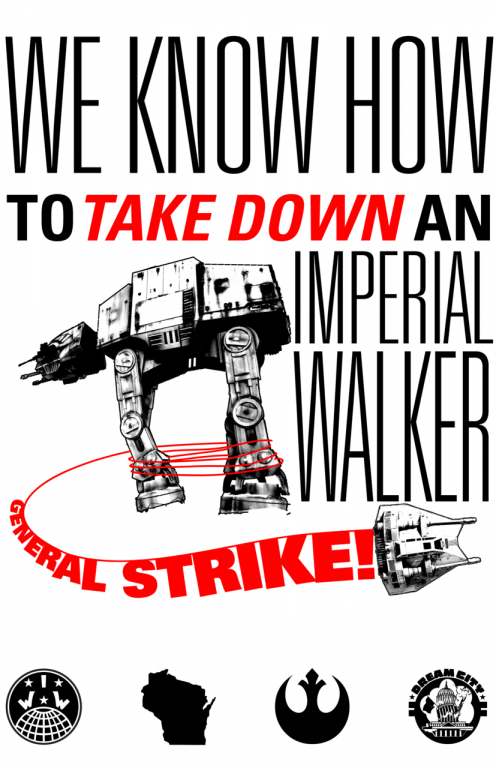 Shortly before Valentine’s day of 2011, Wisconsin Governor Scott Walker announced a budget bill which, along with a package of severe neoliberal cuts to social services, took the unprecedented measure of effectively outlawing unions for state or municipal employees. In order to ‘balance the budget’, the bill made it illegal for unions and public entities to negotiate on any conditions (work safety, hours of work, pensions, healthcare) other than wages, and outlawed any contracts which would give wage increases above the official rate of inflation, unless a referendum was held to approve those raises.
Furthermore unions would no longer be able to rely on the ‘dues check-off’, in which the employer collects the dues on behalf of the union. Finally, unions would be required to undergo a ‘re-certification’ election every year in order to be considered legitimate bargaining agents. On top of this were roughly 20% pay-cuts for all public employees!
From the start, Walker acknowledged the power that workers had to shut down the state: against the possibility of a strike by prison guards who form a large portion of Wisconsin's state employees, he threatened to use the Wisconsin national guard as strikebreakers. To ensure loyalty, the Police and Firefighters’ unions would keep their bargaining rights, although they would still take a pay cut (although this eventually changed).
This was an especially drastic move in the traditionally labor-oriented Wisconsin, home of the first socialist member of Congress and the last socialist mayor of a major city (Milwaukee), not to mention the ‘progressive’ Republicans of ‘Fighting Bob’ Lafollette. On February 14, 2011, after seventeen hours of testimony by the public on how the bill would effect them, the large group of people in the capitol realized that their testimony was not going to stop the bill, and that they were already effectively occupying the Capitol. They decided to stay. At the same time, teachers in Madison and several other school districts held effective sick-outs - in other words unofficial strikes - that were supported by student walkouts and lasted for several days.
In response to this mass ferment of working-class activity there was an emergency meeting of Midwestern IWW members (Twin Cities, Madison, Chicago) to plan an organized response and activity within the growing demonstrations. The participants decided to make an absolute priority of agitating for a general strike. Within this strategy, they examined the specific abilities of the Madison branch, as they were closest to the epicenter. The Madison IWW was a relatively small and somewhat disorganized branch, having a few of Madison’s many worker-owned cooperatives affiliated with it, but with years having passed with no independent shop-floor organizing. The Madison IWW nevertheless had one attribute that many IWW branches lack: of its small membership, a large number were ‘dual-carders’, that is, workers who hold a red IWW membership card along with their membership in a business union. These dual-carders ranged from an apprentice in the building trades to several long-time members of public sector unions, all of whom were known to the labor-left of Madison as basically solid militants.


 Since the February uprising in Wisconsin, which began with a three-week occupation of the Capitol in Madison, the building has been home to a variety of demonstrations and political actions. What perhaps stands out the most is the Solidarity Sing-along, which draws upwards of 100 participants and has been going on for more than 40 weeks. The singers gather in the rotunda each weekday at noon to sing songs that include both traditional labor and protest songs and some new songs penned in the months since Governor Scott Walker first introduced his plans to bust the public employee unions and impose devastating austerity measures on the working class of Wisconsin.
 I was raped by a boyfriend on August 18th, 2006. The very next day I held back tears while I lied to a stranger over the phone about why I was unavailable to go in that day for a second interview for a job that I desperately needed. When I hung up the phone I saw a new text message. It was from him. “It’s not over. It will never be over between us…”
 By Richard Meyers - This article was originally published on