Submitted on Tue, 11/08/2005 - 3:22pm
 This week, we are launching LabourStart TV.
No, it's not a television station. (That would be nice, but we don't have the money for that just yet.) But it is a big step forward for us, and I think for the international trade union movement as well.
Basically, we will start collecting the web addresses of videos produced by and for unions the same way we now do with text-based news stories.
That sounds simple enough, and it is.
But we're doing more than just listing what's available elsewhere on the web.
We're telling trade unionists what other unions have done. We're showing cutting-edge technology that is now fairly widely used in our movement. And we're encouraging other unions to move forward and use the new technology.
A beta version of LabourStart TV is already online. It has no logo nor graphics, and the text is not yet finalized, but it will have these by the end of this week. You can already see it here:
http://www.labourstart.tv
(Don't you just love the simplicity of that address?)
As correspondents, you can already begin adding content now. We will be announcing LabourStart TV towards the end of this week and it would be great to feature content from unions in your country. Here's all you need to do to add shows:
Submitted on Tue, 10/25/2005 - 4:55pm
By Jon Bekken - Industrial Worker, October 2005.
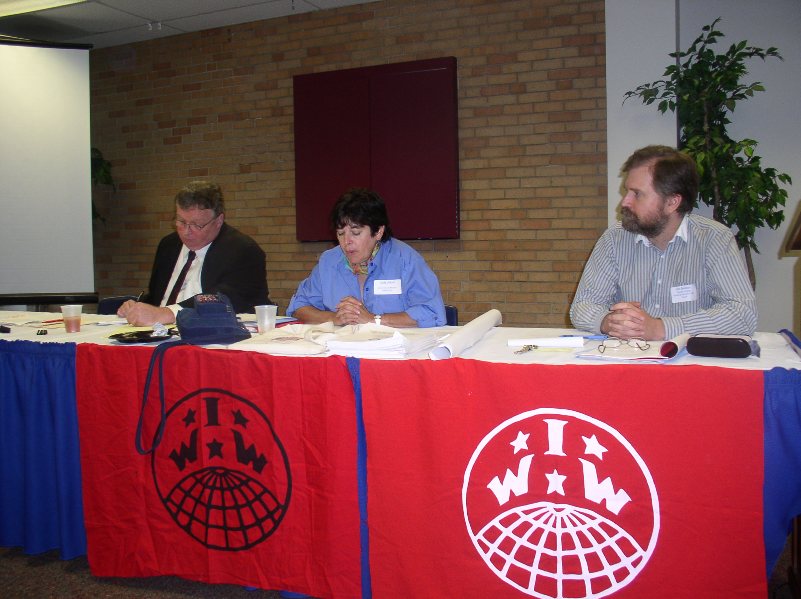 More than 50 economists and labor activists went to Kansas City Sept. 15 – 17 for a conference on radical economics and the labor movement organized as part of the IWW centenary. Presentations addressed a wide variety of topics, from historical work to studies of recent efforts by Latin American workers to defend their labor standards through strikes and worker collectives. Other papers sought to update IWW and Marxian economic analysis, reported on initiatives to bring radical economic analysis to broader audiences, and explored the intersection between radical economics and economic thinkers such as Galbraith and Sraffa. In addition, there was a tour of Kansas City labor history sites (shortened by bad weather), culminating in a performance of Wobbly songs in the old City Market by Bob and Judy Sukiel. The idea was to bring together economists and labor activists for a dialogue which might restore the dialogue between economists and working-class movements that once posed a vital challenge to the dominance of capitalism’s house economists. As Dirk Philipsen of Virginia State University noted in his presentation on historical struggles for economic democracy, “It is clear that corporate capitalism is not sustainable. It is not realistic to believe that it can survive.” And so there is an urgent need to open a conversation about economic alternatives.
Submitted on Sun, 10/09/2005 - 5:51pm
 By Alexis Buss - Industrial Worker, September 2005.
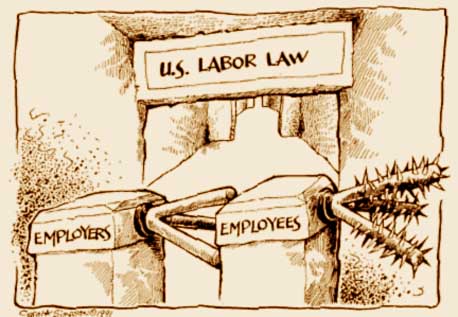
In a stunning turn-around from recent decisions limiting workers' rights, the Bush-appointed U.S. National Labor Relations Board issued a June 7 ruling which requires that every trip to the bar, ballpark or café among coworkers should include discussion of wages, hours and working conditions. Otherwise, workers may not have legal protections for hanging out with one another.
Ok, not quite. The case, which originates in a charge filed by SEIU Local 24/7 against Guardsmark, a San Francisco-based security company, was filed to deal with three Guardsmark work rules relating to workers' abilities to talk to one another, and enlist the support of the public, including the firm's clients:
1) A "chain of command" rule, which says that on-duty workers may only take problems up a chain of command in a very proscribed way, and that workers may not register complaints with the company's clients;
2) A "no-solicitation" rule prohibiting solicitation and the handing out of literature while on duty or in uniform;
Submitted on Sat, 09/17/2005 - 5:03am
Η εργατική τάξη και τα αφεντικά δεν έχουν τίποτα το κοινό.
Submitted on Wed, 09/07/2005 - 3:16am
The following resolution was adopted by the Industrial Workers of the World General Assembly - September 4, 2005:
 Northwest Airlines workers have been on strike since August 20, in a heroic fight against their employers' demands for concessions that would cost thousands of jobs, endanger public safety, and slash wages by 25 percent.
All workers in the air transport industry have a direct interest in turning back the airlines' insatiable demand for concessions, as do all workers in the United States who already suffer from declining wages and massive cuts to health care and other benefits.
However, the Northwest Airlines workers' struggle has been undercut by union scabbing by other Northwest unions, as well as scabbery by unionized air traffic controllers, catering staff and ground crews employed by other airlines and airports around the world but servicing Northwest flights.
The Industrial Workers of the World was formed 100 years ago to promote solidarity, rather than division, among workers.
Both the American Federation of Labor-Congress of Industrial Organizations and the unions grouped in the Change to Win Coalition include in their affiliated unions tens of thousands of workers directly engaged in the air transport industry. Far from calling upon those members to act in solidarity with the Northwest strikers, each has directed their members to actively break the strike by crossing picket lines, handling struck work and otherwise assisting the employers, and have interfered with efforts by affiliated locals to lend aid to their fellow workers at Northwest in their time of need.


